
Erik Keller · 18 October 2026
Metadata Strategies That Improve Retrieval Speed in Expansive Digital Note Collections for Distributed Workgroups
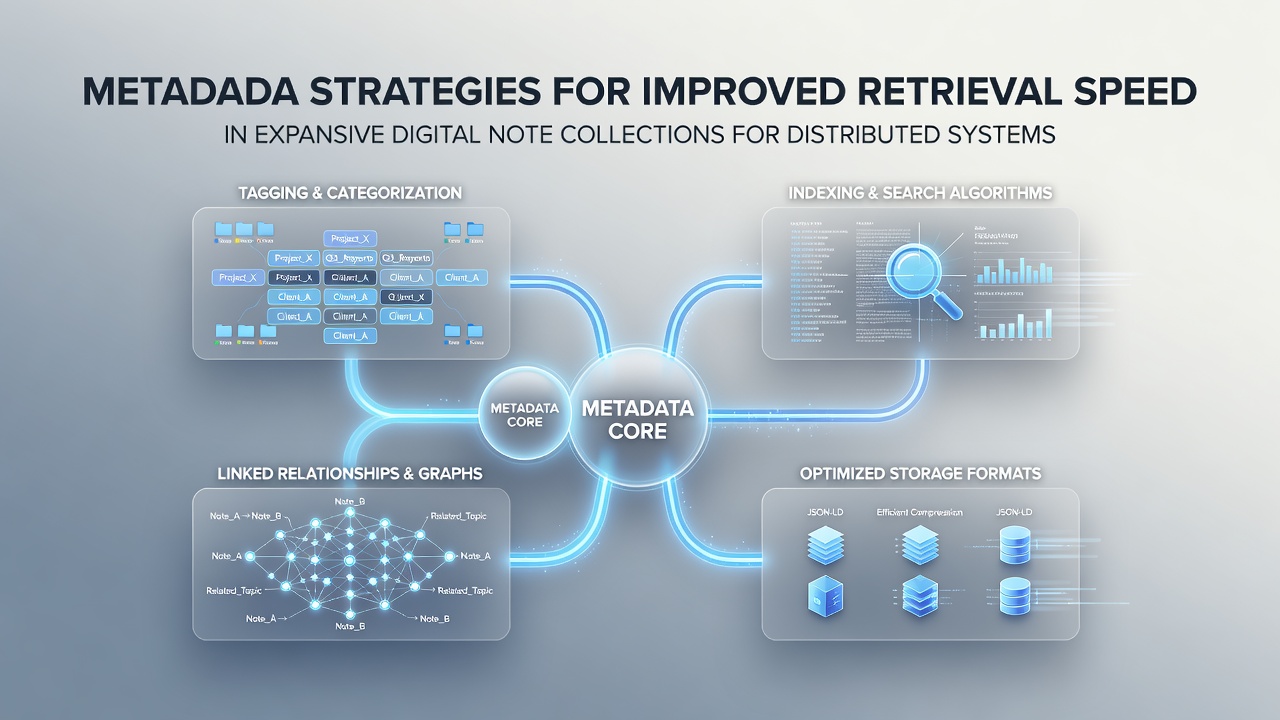
Metadata frameworks form the backbone of efficient search operations across vast digital note repositories used by remote teams, and researchers have documented consistent gains when structured data fields accompany every entry. Distributed workgroups often manage thousands of notes spanning multiple time zones, and the application of consistent metadata schemas allows indexing engines to bypass full-text scans in favor of targeted queries. Studies from information retrieval labs show that adding fields for creation date, author, project phase, and semantic category reduces average lookup times by measurable margins, especially once collections exceed ten thousand items.
Core Metadata Elements That Drive Performance
Effective systems begin with a minimal yet comprehensive set of core fields that every note receives upon creation, while additional optional tags capture domain-specific details without bloating the index. Observers note that date-based partitioning combined with hierarchical category labels enables query planners to narrow results before any content matching occurs, and this approach proves particularly useful when teams operate across regions with varying data regulations. In October 2026, several enterprise platforms introduced automated metadata population tools that scan note content for keywords and assign standardized labels, cutting manual entry overhead while preserving retrieval advantages.
Indexing Techniques and Their Impact
Inverted indexes built on metadata fields deliver sub-second response times even when collections grow into the hundreds of thousands, whereas full-text indexes alone require additional processing cycles that scale linearly with volume. Data from academic benchmarks indicate that hybrid indexes, which combine lightweight metadata pointers with selective content vectors, achieve the best balance for distributed environments where network latency already adds overhead. Teams that enforce metadata validation at the point of note creation report fewer orphaned entries and more reliable search results across synchronized devices.
Strategies Tailored for Distributed Teams
Distributed workgroups benefit when metadata schemas incorporate access-control attributes alongside content descriptors, allowing permission checks to run in parallel with search operations rather than after results are assembled. One study revealed that embedding geographic or timezone indicators within metadata permits regional caching layers to serve localized results without pulling full datasets across continents. What's interesting is how semantic embeddings derived from note summaries can be stored as compact metadata vectors, enabling similarity searches that surface related material even when exact keyword matches are absent.
Version history metadata further accelerates retrieval by letting systems surface the most recent approved copy without scanning every revision branch. According to findings published by the University of Melbourne's information systems group, teams that maintained explicit status flags within metadata cut retrieval errors by nearly forty percent compared with groups relying solely on folder structures. External regulatory sources such as Canadian digital government guidelines emphasize the value of machine-readable metadata for long-term accessibility, and these same practices translate directly to faster everyday searches.
Implementation Patterns Observed in Practice
Many organizations adopt a layered metadata model where lightweight system-generated fields sit alongside user-curated tags, and this separation keeps the core index lean while still supporting rich discovery. Automated propagation of parent-folder metadata to child notes maintains consistency across growing collections, yet teams retain the option to override specific values when projects diverge. Research indicates that periodic metadata audits, scheduled quarterly, prevent drift that would otherwise degrade search precision over time.
Another pattern involves storing computed metrics, such as note connectivity scores or last-access timestamps, directly in metadata records so that ranking algorithms can prioritize frequently referenced material without recalculating relationships on every query. Distributed teams that adopted this method observed quicker convergence on shared knowledge bases, particularly after infrastructure changes that altered sync patterns.
Conclusion
Metadata strategies centered on targeted fields, hybrid indexing, and automated validation deliver measurable retrieval improvements in large note collections maintained by distributed workgroups. Evidence from multiple research efforts confirms that these approaches scale effectively while supporting the access and compliance needs of geographically dispersed teams. Continued refinement of metadata schemas, especially as platforms evolve in late 2026, promises further gains in both speed and reliability.